
There is a ventilation conversation happening at kitchen tables all over the DFW metroplex right now. A roofer comes out to bid your job. He walks the roof, takes a couple of measurements, and then he tells you with total confidence exactly what your attic needs. Ridge vents. Or a power fan. Or a radiant barrier. Whatever he is selling that season.
Most of them are wrong. Not because they are bad people. They are wrong because they are reading you the same manufacturer brochure you could read yourself.
I have been on roofs and crawling through attics in this part of Texas for a long time. More than six decades as a company, and over a decade of doing nothing but watching how different ventilation systems age out in our climate. I am going to tell you what we learned by being bent over your roof and stuck in your attic, six days a week, for years. Not what a product label promises. What actually holds up when the thermometer hits 105 outside and your attic hits 150.
This is going to be a long one. Bookmark it. By the time you finish, you will know more about attic ventilation than the contractor standing in your driveway. Keep reading. You are going to be glad you did.
Why This Matters More Than You Think
Let me show you the stakes first, because most homeowners do not understand them.
On a hot Texas afternoon, your roof deck can sit well above the outdoor air temperature. The shingles soak up the sun. That heat drives down into the wood, and the wood radiates it into the air space below. An attic that is not moving air can run 140 to 160 degrees on a bad day. That is not an exaggeration. That is a Tuesday in July around here.
That trapped heat does four expensive things at once.
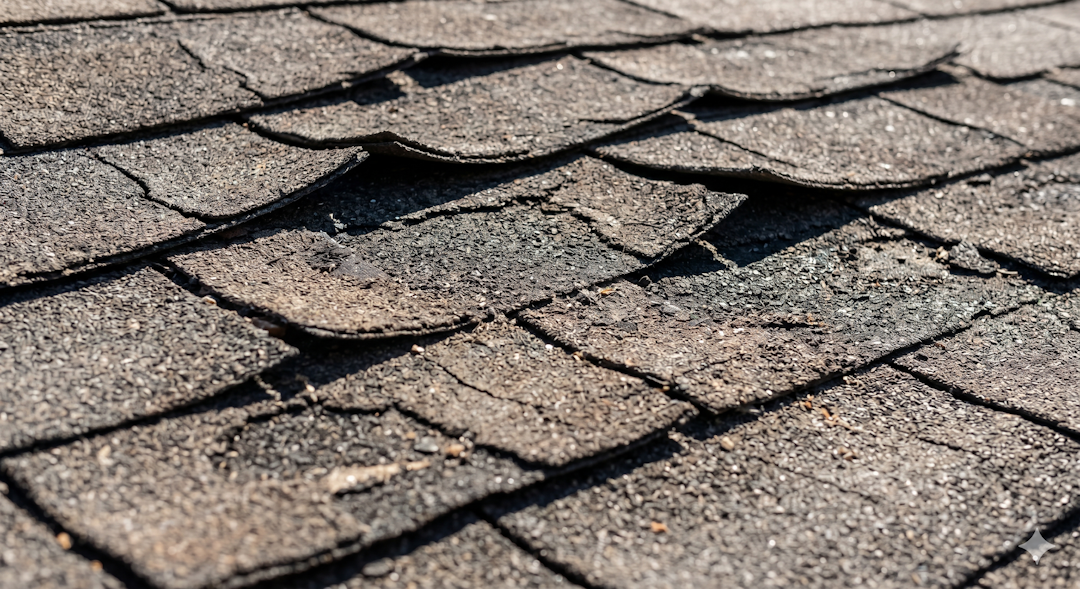
It cooks your shingles from the underside. Asphalt shingles are not designed to bake from below for years on end. When they do, the matting ages early. The shingle starts to crack, curl, and shed its protective granules. A roof that should give you twenty-five years starts failing at twelve or fifteen.
It punishes your air conditioner. In most Texas homes the air handler and the ductwork sit right up there in that 150-degree box. Your system is fighting that heat every minute it runs. You pay for that fight on your electric bill.
It traps moisture. Heat is the obvious enemy in summer, but a stagnant attic also holds humidity. Over time that shows up as rusted nail tips, dark stains on the underside of the decking, damp insulation, and the start of mold. Ventilation is not just a summer comfort issue. It protects the bones of your roof year round.
And it quietly voids your warranty. This is the part nobody tells you. We will get to it in a minute, and it is the most important thing in this whole article.
So ventilation is not a small upgrade. It is the difference between a roof that lasts and a roof that fails early while everyone points fingers about whose fault it was.
The One Rule Nobody Explains To You
Here is the single biggest reason ventilation systems fail. It is not the brand of vent. It is balance.
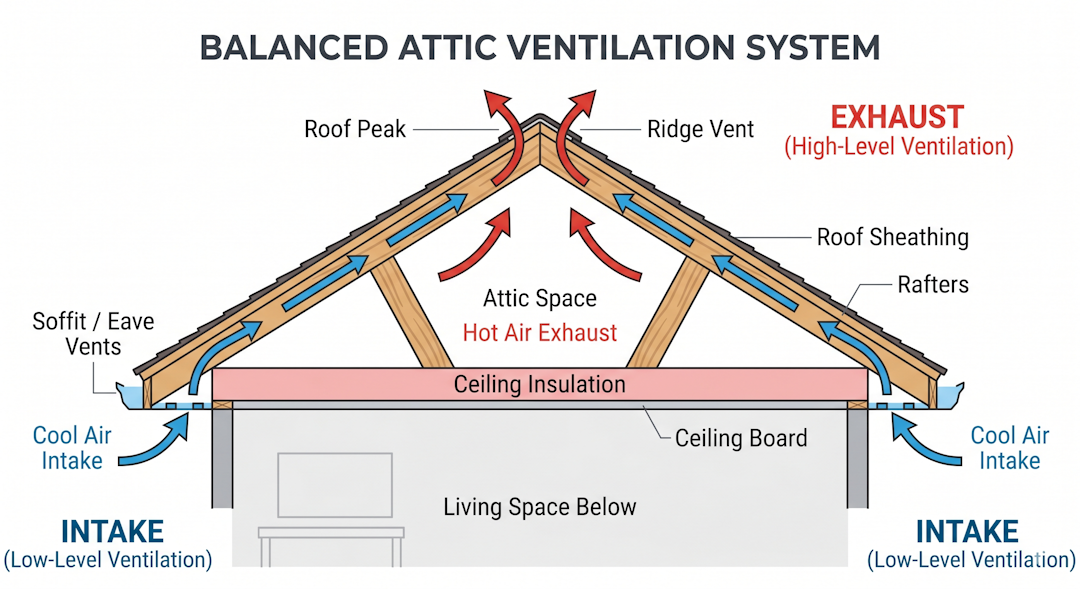
A roof breathes the way you do. Air comes in low, down at the eaves through the soffit vents. That is intake. Hot air goes out high, up near the peak through the ridge, the turbines, or the fans. That is exhaust. Hot air rises, escapes at the top, and pulls fresh outside air in at the bottom. That natural pull is called the stack effect. When intake and exhaust are balanced, the whole attic breathes on its own with no moving parts.
There is even a number for how much you need. The roofing codes use net free area, which is the actual open area in a vent after you account for the screens and louvers. The common standard is one square foot of net free area for every 150 square feet of attic floor, and that total should be split evenly between intake and exhaust. With a vapor barrier and a properly balanced high-and-low system, some codes allow a more relaxed one-to-300 ratio.
Now here is the rule almost no contractor explains. Your intake should always be equal to or greater than your exhaust. Never the other way around.
Think about what happens when you get that backwards. If a roof has more exhaust than it has intake, all those vents up top still need to pull air from somewhere. If they cannot get enough from the soffits, they start pulling it from the next easiest hole. Sometimes that is another vent on the roof, which means they are short-circuiting and sucking weather and dust right back in. Sometimes, worse, that air gets pulled up out of your living space through gaps around can lights and the attic hatch. Now you are paying to air-condition your attic.
Most failed ventilation jobs in this area are not failing because the homeowner bought the wrong vent. They are failing because the attic is starved for intake. Remember that. It is the thread that ties this entire article together.
The Radiant Barrier Story, Told Straight
For a stretch, radiant barrier was the answer everyone wanted to hear. Spray it on the underside of the decking, or buy decking with the foil already laminated on, and watch your attic temperature drop. And it does drop. Walk into a freshly barriered attic and you will feel it right away. Cooler.
A radiant barrier works by reflecting the sun’s radiant heat back up toward the roof instead of letting it pour down into the attic. That is great for the air handler sitting in your attic. But that reflected heat has to go somewhere, and where it goes is back into the underside of your shingles.
For years some of us in the trade swore that radiant barrier was cooking shingles early. We saw cracked, curled, granule-bald shingles over barriered decks and we connected the dots. We were partly right and partly wrong, and the truth is more useful than either side of that old argument.
Here is what the building science actually shows. A radiant barrier by itself only raises shingle temperature a small amount. Most studies put it in the range of a few degrees, not the inferno some of us blamed it for. And no major shingle manufacturer voids your warranty just because a radiant barrier exists in your roof system.
So why did so many roofs over radiant barrier fail early? Because of what was, or was not, behind that barrier. A radiant barrier laid tight against the decking, in an attic that was already short on airflow, traps heat and humidity right where it does the most harm. The barrier did not kill those roofs on its own. The barrier plus poor ventilation did.
And now we get to the warranty trap, which is the whole reason this matters to your wallet.
Read the fine print on almost any shingle warranty and you will find the same escape hatch. The manufacturer will not cover premature shingle deterioration caused by excessive temperatures from inadequate or improper ventilation. They will not cover damage caused by the deck underneath. They will not cover shingles installed outside their instructions or local code.
Do you see the trap? A homeowner files a claim for shingles that aged too fast. An inspector goes up, finds an attic that was never properly ventilated, and the claim is denied. Now the homeowner is out of pocket for a roof that failed early, and the only honest explanation is the one nobody checked before the work was done. Ventilation.
That is why we treat ventilation as the foundation of the whole roof, not an accessory. Get it wrong and you do not just shorten the life of the shingles. You hand the manufacturer a legal reason to walk away from your warranty.
Keep reading. Now that you understand balance and the warranty trap, the rest of the vent types make a lot more sense.
Wind Turbines: The Old Workhorse
Wind turbines are the spinning ball-shaped vents you have seen on roofs your whole life. They are the oldest and the cheapest exhaust option out there. Wind spins the head, the spinning creates a little suction, and that pulls hot air up and out. No electricity. Almost no maintenance to run them.
I am not too proud to respect a turbine. On a roof with good soffit intake, a properly sized and properly placed turbine moves a real amount of air for almost no money.
They are not perfect. They get knocked around by falling limbs and high wind. Hail dents them. As the bearings age they start to squeak and rattle, and some homeowners cannot stand the noise. They are also entirely at the mercy of the weather. On a dead-still Texas afternoon, a turbine is just sitting there.
Even with all that, some exhaust beats no exhaust. A turbine that moves air on a breezy day is doing more for your shingles than a bare roof doing nothing. For a lot of homes, the humble turbine still earns its keep.
Power Fans: Powerful, And That Is The Problem
Power vents are the muscle of the group. An electric motor spins a fan blade, a thermostat kicks it on at a set temperature, and it forces hot air out of the attic. On paper they are the most powerful exhaust you can buy.
I will even agree with that. Power fans are the strongest form of exhaust on the market. Right up until something goes wrong. And something always goes wrong.
Start with the motors. They burn out. Often inside one to five years, and most of them carry only a one or two year warranty. Heat, dust, insulation, the occasional lightning surge, the occasional nesting critter, all of it shortens a motor’s life. The cruel part is that a dead fan looks exactly like a working fan from the ground. Plenty of homeowners have a burned-out fan baking their attic for two summers and have no idea.
But the burnout is not even the real problem. The real problem is what a strong fan does to the rest of your house.
A power fan pulls hard. If your intake cannot keep up, and on most homes it cannot, that fan will pull its makeup air from wherever it can get it. In a lot of houses that means it reaches down through gaps in the ceiling and pulls cooled, conditioned air straight up out of your living space and blows it outside. You are now running your air conditioner to cool your attic. The fan feels like it is working because the attic got cooler. It got cooler partly on your dime.
There is a safety angle too, and it is not small. A strong fan can put the attic, and sometimes the house, under enough negative pressure to backdraft a gas water heater or furnace. That can pull combustion gases, including carbon monoxide, back into the living space. That is a serious risk in a home with gas appliances, and it is the kind of thing the brochure never mentions.
Some power fans run for years with no trouble. But between the burnout rate, the maintenance, the extra electrical work to wire them, and the pressure problems, they are too much gamble for too little gain on most homes. We rarely recommend them anymore, and now you know why.
Solar Fans: A Real Step Forward
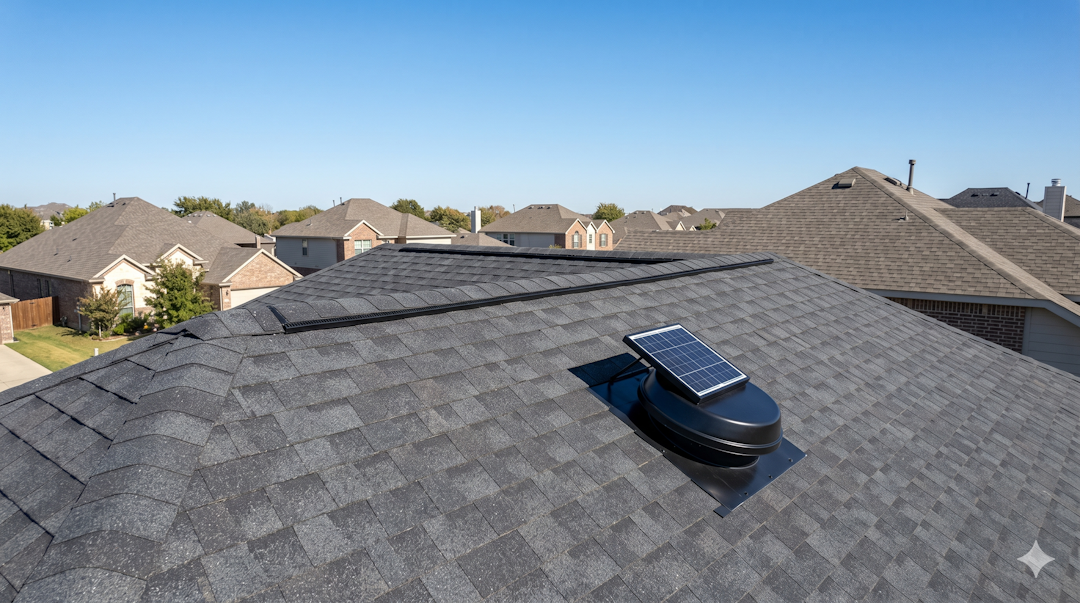
Solar fans are the smarter cousin of the power fan. Same idea, a motor spinning a fan, but a small solar panel runs it instead of your house current. No wiring. No electric bill. The motor only runs when the sun is out, which happens to be exactly when your attic needs the help most.
In our own ten-year ventilation experiment, solar fans performed well. Off the shelf they cost about what a power fan costs, but they are cheaper to own because they run for free and skip the electrician.
Here is the catch, and it is the same catch that applies to every vent in this article. No single form of ventilation is enough on its own. Not even a good solar fan. Texas heat is relentless, and one vent type working alone will always struggle to keep up. A solar fan needs a partner. Stay with me, because that partner idea is the whole secret.